7 pillars of a crypto plan for the next cycle
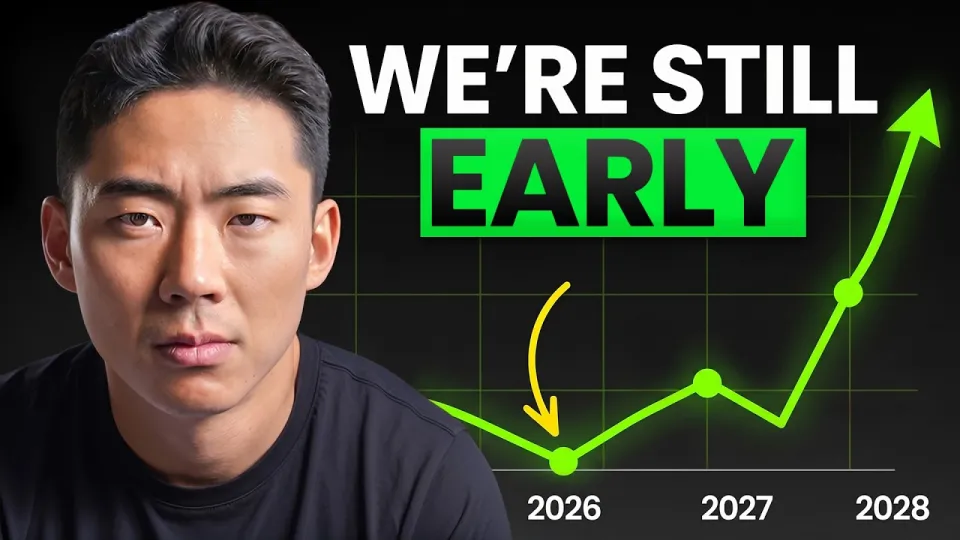
Video: my plan to make millions in crypto 2027
Want articles like this for your own video to promote it on YouTube and Google? Order them through the Telegram bot @sat_sit_bot. It writes articles around your video, embeds the video and publishes them on popular niche websites (no ads). Try it free: 50 articles on us.
· based on the channel Brian Jung
A crypto plan for the next cycle works best as a written framework rather than a set of price targets: define the thesis, pick the narratives, size positions by conviction, and set exit rules before the market forces your hand. Brian Jung's breakdown of his own plan follows exactly that order, and the Kaizen Pro product page is where he hosts the paid research layer that sits on top of it.
Why the crypto bull case holds together
The bull case is not one story but four reinforcing ones, and each can be tracked with public data.
- Macro liquidity. Rate cuts and looser financial conditions historically push capital toward risk assets, and crypto is the highest-beta liquid risk asset available to retail investors.
- Institutional plumbing. Spot Bitcoin ETFs turned a niche asset into something an advisor can allocate to inside a standard brokerage account. Every quarter of inflows is a structural bid that did not exist in earlier cycles.
- Regulation that is clearer, not necessarily friendlier. Even if regulators reject some proposals, clarity itself reduces the legal risk that keeps large allocators on the sidelines. A rejection of a bank-friendly framework is not automatically bearish for the asset class.
- Cash flow. A growing set of protocols earns real fees from real users, which gives analysts something to value beyond the next narrative rotation.
The honest counterpoint, raised constantly by long-time holders, is that being bullish is not a prediction. A thesis can be right on fundamentals and still deliver a 60% drawdown along the way. The plan has to survive that, or it is not a plan.
The narratives that drive the next crypto cycle
Narratives are where capital concentrates before fundamentals catch up, so the plan groups them into buckets instead of picking single tokens.
- Bitcoin and ETF flows. BTC remains the index of the asset class; ETF inflows and corporate treasury buying are the clearest demand signals.
- Ethereum and layer 2s. Ethereum's roadmap keeps pushing activity to rollups, which changes where fees and value accrue.
- High-throughput layer 1s. Solana and Sui come up repeatedly as the chains where consumer and trading activity is actually happening.
- DeFi and real-world assets. Tokenized treasuries and on-chain credit are the most institution-friendly corner of crypto.
- AI plus crypto. Compute marketplaces, agent payments and data networks attract speculative capital fast and lose it just as fast.
- Consumer apps and social tokens. The retail on-ramp narrative returns every cycle in a new wrapper.
A useful discipline is to assign each bucket a maximum weight and a thesis sentence, then check quarterly whether the thesis is still true rather than whether the price went up.
How to size a crypto portfolio without blowing up
Sizing, not selection, decides whether a cycle is profitable. A workable structure has three tiers.
- Core (roughly 40–60%): Bitcoin and Ethereum, held through volatility, rebalanced rather than traded.
- Growth (roughly 25–40%): one or two narrative leaders per bucket with genuine usage, bought in tranches on weakness.
- Speculative (5–10% maximum): new launches, memecoins and high-yield plays, treated as money you can lose entirely.
Two rules make the tiers real. First, never let the speculative sleeve grow past its cap after a lucky run; trim it back. Second, decide in advance what invalidates each position, whether that is a broken roadmap, declining fees or a lost developer base, and act on it without renegotiating.
Risk management rules that protect the plan
The most common way to lose in crypto is to be directionally right and positionally wrong. Leverage is the usual culprit: a 3x position needs only a 33% drawdown to be wiped out, and 30–40% drawdowns are routine even in bull markets.
Practical guardrails:
- Keep leverage at zero in the core tier and cap it tightly, if used at all, in the speculative tier.
- Pre-commit profit-taking levels, for example selling 20–25% of a position each time it doubles.
- Hold stablecoin reserves so drawdowns are buying opportunities rather than forced exits.
- Track portfolio value in fiat terms weekly, not hourly; frequent checking increases the odds of emotional decisions.
- Write down the exit plan before entering, including the scenario where the cycle top arrives earlier than expected.
Questions traders keep asking about cycle timing
Timing debates dominate every crypto discussion, and the plan should answer them explicitly rather than implicitly.
- When is the top? Nobody knows, and confident predictions ranging from the near term to several years out are guesses dressed as analysis. The plan uses trailing stops and staged selling instead of a date.
- Is a regulatory rejection bad? Not necessarily. Clear rules, even restrictive ones, can be better for adoption than years of ambiguity, and crypto's original appeal was precisely that banks do not control it.
- Should altcoins be half the portfolio? Only if the holder can tolerate a 70–80% drawdown in that half without selling. For most people that means a smaller altcoin allocation than they initially want.
- What if the thesis is wrong? The core tier and stablecoin reserve are the fallback; the speculative tier is sized so that being wrong is survivable.
Tools and resources from the breakdown
The research workflow behind the plan runs through a small set of links worth bookmarking.
- Kaizen Pro waitlist — the paid research and community product.
- Free crypto market report newsletter — the weekly market breakdown.
- Brian Jung on X and Instagram — shorter-form updates.
- Risks and disclaimers document — the full disclosure behind the content.
The bottom line on building a crypto plan
A cycle plan is a written thesis, a narrative map, tiered position sizes and pre-committed exit rules, reviewed on a schedule instead of on emotion. The bull case for crypto rests on liquidity, institutional access, clearer rules and real protocol revenue, and each of those can be checked with data. The failure mode is not being wrong about the direction; it is buying late with leverage and selling the bottom in fear. Brian Jung's video breakdown is a useful template for structuring the process, but the numbers in your own plan should reflect your time horizon and how much you can genuinely afford to lose.
If you want the research layer that accompanies this framework, start with the Kaizen Pro waitlist.
Key takeaways
- Brian Jung's cycle plan is built on four pillars: macro liquidity, ETF and institutional inflows, real revenue-generating protocols, and consumer apps.
- The bull case rests on falling interest rates, spot ETF demand and crypto-friendly regulation rather than on a single narrative.
- Narrative buckets to watch: Bitcoin and ETFs, Ethereum layer 2s, Solana and Sui, DeFi and RWAs, AI plus crypto, and consumer apps.
- Position sizing should be tiered: core BTC and ETH, mid-cap narratives, and a small speculative sleeve capped at a few percent.
- The biggest documented failure mode is buying late-cycle hype with leverage, then panic-selling the drawdown.
Source: my plan to make millions in crypto 2027 · Markdown version
Questions & answers
Is crypto still worth investing in during this cycle?
The case rests on four checkable factors: looser macro liquidity, steady spot ETF inflows, clearer regulation and protocols that earn real fees. None of them guarantees price direction, and 30–40% drawdowns remain normal. Size positions so a deep drawdown does not force you to sell.
How much of a crypto portfolio should be in altcoins?
A common structure is 40–60% in BTC and ETH, 25–40% in established narrative leaders and no more than 5–10% in speculative tokens. Altcoins can fall 70–80% in a bear phase, so the allocation should be an amount you can hold through that without panic selling.
Does a regulatory rejection hurt crypto?
Not necessarily. Regulatory clarity, even when restrictive, can reduce legal uncertainty for large allocators and reinforce crypto's original appeal of operating outside bank control. The market reaction often depends more on whether the rules are clear than on whether they are friendly.
When will the crypto cycle top arrive?
No one can time it reliably, and predictions spanning the near term to several years out are guesses. A more practical approach is staged profit-taking, trailing stops and a pre-written plan for the scenario where the top comes earlier than expected.